
2027 Budget Notable Points
November 2026 – The City began its budget season earlier in 2026, with a scheduled “Mid Year Hearing” in July 2026. This built on a series of transparency reforms following the 2025 Budget, which includes a mid-year report and other public data (such as monthly “Workforce Vacancy” reports). On Wednesday, October 21, the Mayor gave his budget address to the City Council, and also released the 2027 Budget recommendations and overview. You can follow all budget ordinance documents at the City Clerk’s 2027 budget website, and also use the individual links in the appendix below.
The 2027 Budget Forecast projected a gap of $882.4 million, which was subsequently reduced by $140.4 million due to adjustments from the forecast; an increase Tax Increment Finance Surplus; and improved revenue projections. The 2027 recommended budget as proposed includes more than $130 million in proposed investments that have moved to the Corporate Fund (the City’s general fund), or expansions in service:
$30.9 million in funding is moved off of the Library Fund (which is supported by Property Taxes) and onto the Corporate Fund
$30 million for housing & homelessness support
$24 million for expanded youth employment programming
$14.5 million for expanded Streets & Sanitation services (such as Bureau of Forestry improvements)
The 2027 recommended budget also proposed to balance the expenditures and revenues of the Corporate Fund by removing an operating cost, for settlements and judgments, as a part of a $480 million borrowing package. The 2027 proposed budget also incorporated $75 million in revenue from the private transfer of the Chicago Parking Meter Concession System, instead of placing that revenue toward pension payments (as required by the CPM authorizing ordinance passed by City Council earlier in 2026). Additionally, the City proposes raising more revenue via numerous Municipal Code amendments, but most prominently:
An increase in the City’s Personal Property Lease Tax, which taxes cloud computing and similar services
An updated “Corporate Head Tax,” called an Equitable Employer Tax, which will tax corporations with 125 employees and provide credits for companies who locate in City-designated Socioeconomically Disadvantaged Areas.
Pressure Points
After the passage of the 2026 Budget, the 1st Ward office analyzed numerous pressure points within the City budget. Following this analysis, the 1st Ward Office is following a number of proposals in the 2027 Budget as they pertain to ongoing structural budget issues. There are at least $300 million of evident pressure points in the budget as currently proposed, excluding the $480 million in borrowing for Settlements and Judgments:
Earlier in 2026, the ordinance that set the terms for amending the Chicago Parking Metered (CPM) Concession agreement, in order to finalize the private sale of the parking meter system, established a one-time $75 million payment to be applied to the pension system, as well as additional share in the net operating income from the system, and a percentage fee for any future sale of the system. In November 2026, the City Council convened a special meeting to immediately apply the $75 million payment (which was received) to the pension system (Alderman La Spata supported this good governance ordinance, to follow the terms of the CPM Concession Agreement Ordinance). By contrast, the City’s budget one-pager suggests that this $75 million payment was to be expected for improved revenue sources for the Corporate Fund (the City’s general fund).
After the Chicago Public Schools (CPS) previously failed to make some of its promised pension payment for its share of the MBEAF pension over the last few years, for which many CPS staff are members, it is not apparent that this 2027 Budget expects a reimbursement from CPS for its share of the pensions. Based on previous budgets, it could be expected that this reimbursement would be worth at least $150 million to the City.
There is an updated version of the so-called “Corporate Head Tax” in this year’s budget named the Equitable Employer Tax. This tax is expected to bring in $113.8 million to the Corporate (general) Fund, which funds a new “SEDA Employment Expansion and Development” charge ($12 million). You can read about this version of the tax in Article VII of the 2027 Revenue Ordinance (PDF page 19), which is generally applied to businesses with 125 or more full-time employees (among other specifics); however, businesses may apply for a credit for each employee that they locate within a designated Socioeconomically Disadvantaged Area of the City. Ostensibly, the goal of this program is to incentivize investment within areas that have previously experienced disinvestment. A majority of City Council alderpersons have sent a letter to Mayor Johnson stating their objection to this ordinance, and so voting down this ordinance would create another $102 million gap in the budget.
In the 2026 Budget, the City passed a Social Media Amusement Tax (also commonly referred to as the SMART Tax), which they did not appropriate due to the expectation of litigation. In the 2027 Budget, despite ongoing litigation, the City has appropriated all SMART Tax proceeds, and is using those proceeds to create a special revenue fund called the “Protecting CARE Fund.” This fund is proposed to be the home to the City’s alternative response to policing program; gender-based violence programs; violence reduction programs; child sexual abuse survivors programs; mental health functions; and other public health functions (epidemiology, community engagement, etc.). If the City loses its lawsuit, it will need to repay all collected proceeds, and find alternate revenue sources for $98 million of social services programming.
The 2027 Budget only proposes to raise the property tax levy by roughly $12 million, which simply accounts for new expected properties on the rolls, and thus the levy is at least $34 million behind basic inflation from September 2025 to September 2026. This places pressure on Chicago Library services, which now have a $30 million subsidy in the Corporate (general) Fund, despite the Library having its own portion of the levy.
The $480 million in borrowing for judgments and settlements is estimated to cost Chicagoans more than $180 million over the next 5-7 years.
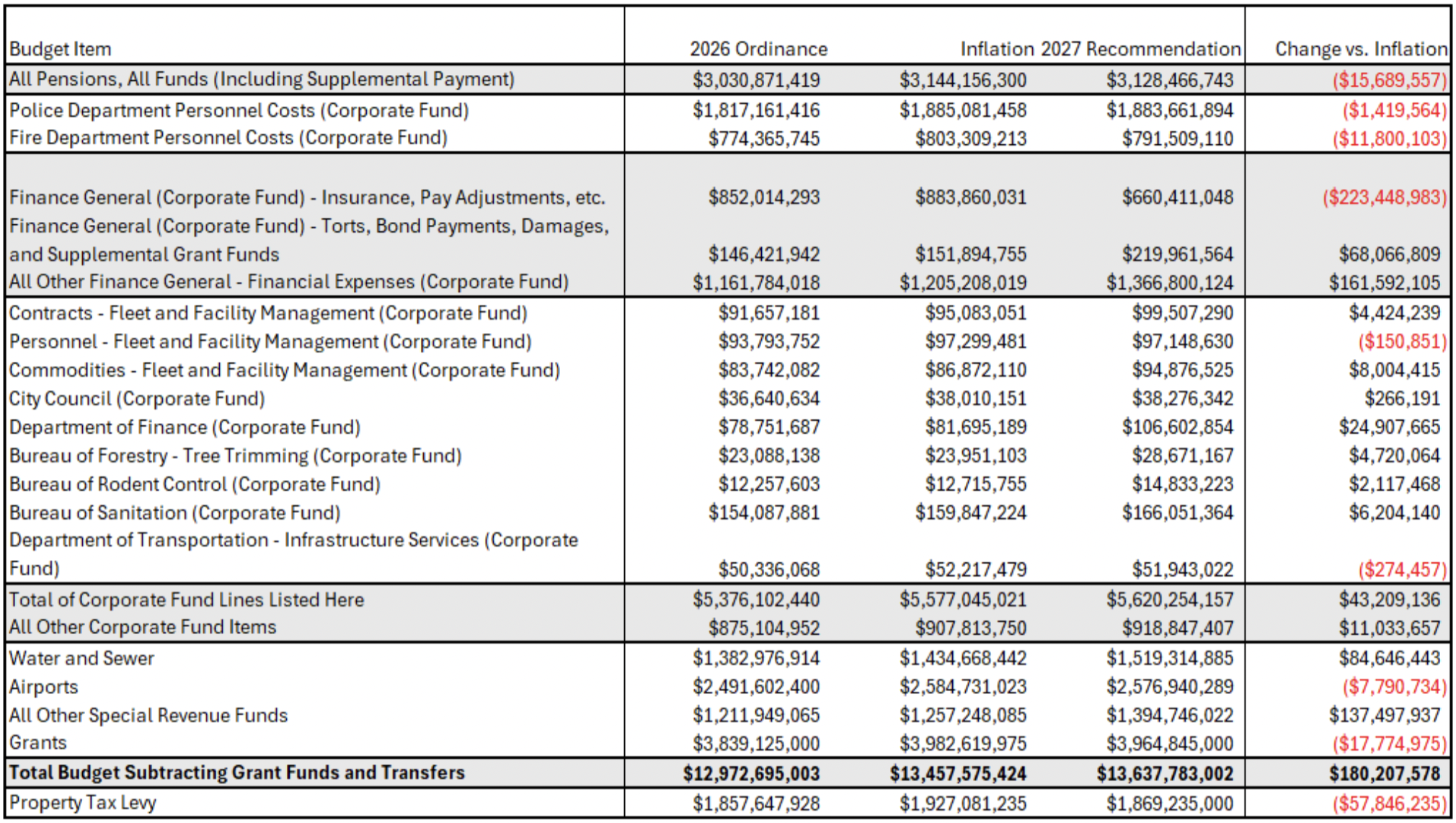
Updated Table – Largest Budget Lines (Compare to Budget Blog 20)
Appendix: City Budget Documents
Comprehensive Annual Financial Reports (annual required audit)
2027 Budget Recommendations (line by line budget)
2027 Grant Detail Report (line by line appropriation and carryover of grant funds)
2026 Revenue Reports (September 2026 latest)
Committee on Budget and Government Operations documents